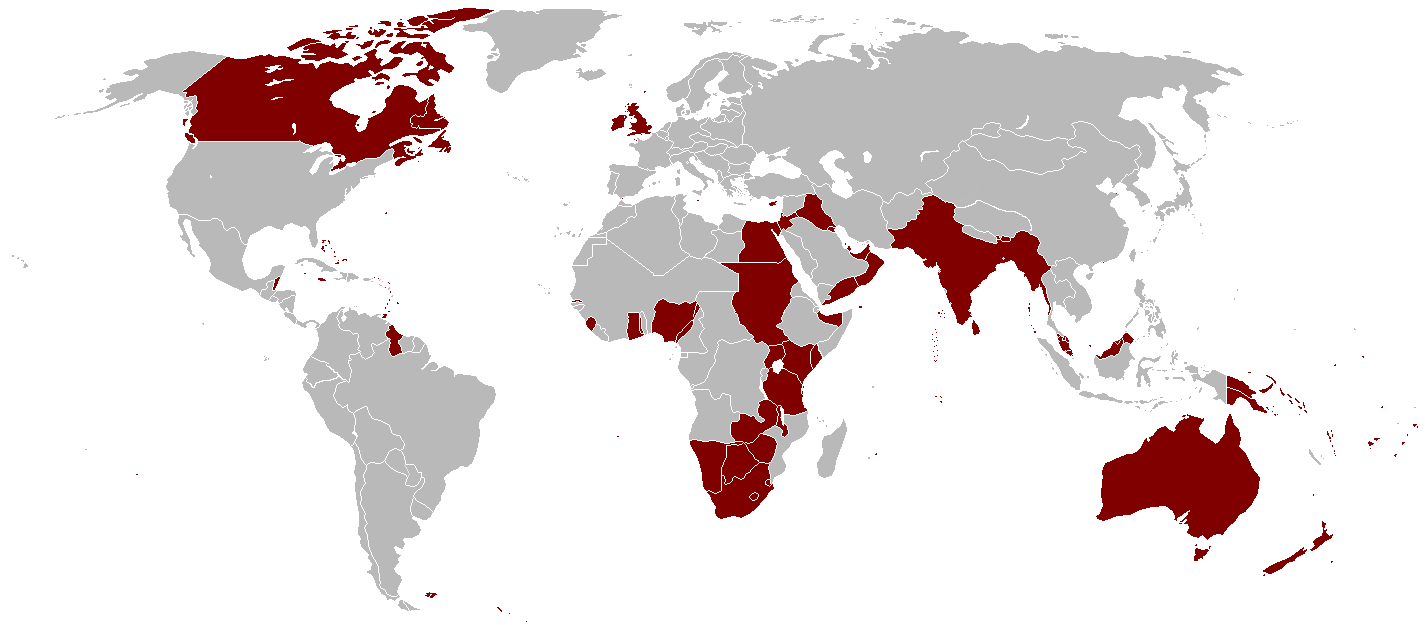
Image credit: Illustrative map of British imperial territories circa 1921, by Vadac and Wikimedia Commons contributors, public domain. Borders and territorial statuses are simplified. Original file unchanged; card display may be cropped.

The British Empire's colonial policies, particularly the strategies of "divide and rule" and the establishment of arbitrary borders, have significantly contributed to conflicts in various regions. Below is a list of countries where British actions have been instrumental in creating conflicts, along with the associated wars and estimated casualties:
India and Pakistan
Conflict: Partition of British India (1947) leading to the Indo-Pakistani Wars.
Details: The British decision to partition India into two dominions, India and Pakistan, based on religious majorities, led to mass migrations and violence.
Estimated Casualties: Partition violence resulted in approximately 200,000 to 2 million deaths, with around 15 million people displaced.
Asia SocietyAsia SocietyAsia Society
Israel and Palestine
Conflict: Arab-Israeli Conflict.
Details: The British Mandate for Palestine and the subsequent withdrawal in 1948 without a clear resolution led to the establishment of Israel and ensuing conflicts with Palestinian Arabs.
Estimated Casualties: The 1948 Arab-Israeli War resulted in approximately 13,000 Arab and 6,000 Jewish deaths.
Nigeria
Conflict: Nigerian Civil War (1967–1970).
Details: British colonial policies exacerbated ethnic divisions, particularly between the Igbo, Yoruba, and Hausa-Fulani groups, leading to the secession of Biafra and the ensuing civil war.
Estimated Casualties: Between 1 and 3 million people died, primarily due to starvation.
Sudan and South Sudan
Conflict: First and Second Sudanese Civil Wars.
Details: British colonial administration favored the Arabized north over the predominantly African south, leading to prolonged conflicts post-independence.
Estimated Casualties: Combined, both wars resulted in over 2 million deaths.
Sri Lanka
Conflict: Sri Lankan Civil War (1983–2009).
Details: British colonial policies favored the Tamil minority in administrative roles, creating tensions with the Sinhalese majority, eventually leading to civil war.
Estimated Casualties: Approximately 80,000 to 100,000 people died.
Iraq and Kuwait
Conflict: Iraq's invasion of Kuwait (1990).
Details: The British-drawn borders post-World War I left territorial disputes, including Iraq's claim over Kuwait, leading to the Gulf War.
Estimated Casualties: The invasion and subsequent Gulf War resulted in thousands of deaths, including combatants and civilians.
Kenya
Conflict: Mau Mau Uprising (1952–1960).
Details: British colonial land policies marginalized the Kikuyu people, leading to the Mau Mau rebellion against colonial rule.
Estimated Casualties: Approximately 11,000 Mau Mau fighters and civilians were killed.
Cyprus
Conflict: Cyprus Emergency (1955–1959).
Details: British colonial rule and the divide between Greek and Turkish Cypriots led to the EOKA insurgency for union with Greece.
Estimated Casualties: Around 500 British personnel, 90 EOKA fighters, and numerous civilians died.
Malaysia
Conflict: Malayan Emergency (1948–1960).
Details: British colonial economic policies and ethnic tensions led to a communist insurgency in Malaya.
Estimated Casualties: Approximately 11,000 people died, including insurgents, civilians, and security forces.
Yemen
Conflict: Aden Emergency (1963–1967).
Details: British colonial presence in South Yemen faced opposition from nationalist groups, leading to an insurgency.
Estimated Casualties: Around 2,000 people died, including British military personnel and local insurgents.
These examples illustrate how British colonial policies, including arbitrary border delineation and divisive governance strategies, have had lasting impacts, contributing to conflicts and significant loss of life in various regions.
Share this article
A PRIVATE CONVERSATION
Share your thoughts
Have a question or a perspective to share? Send me a private message about this article. Your message and contact details will not be published.